The Lunar Development Cooperative
An Institution for Growing a Sustainable Lunar Economy
The Concept
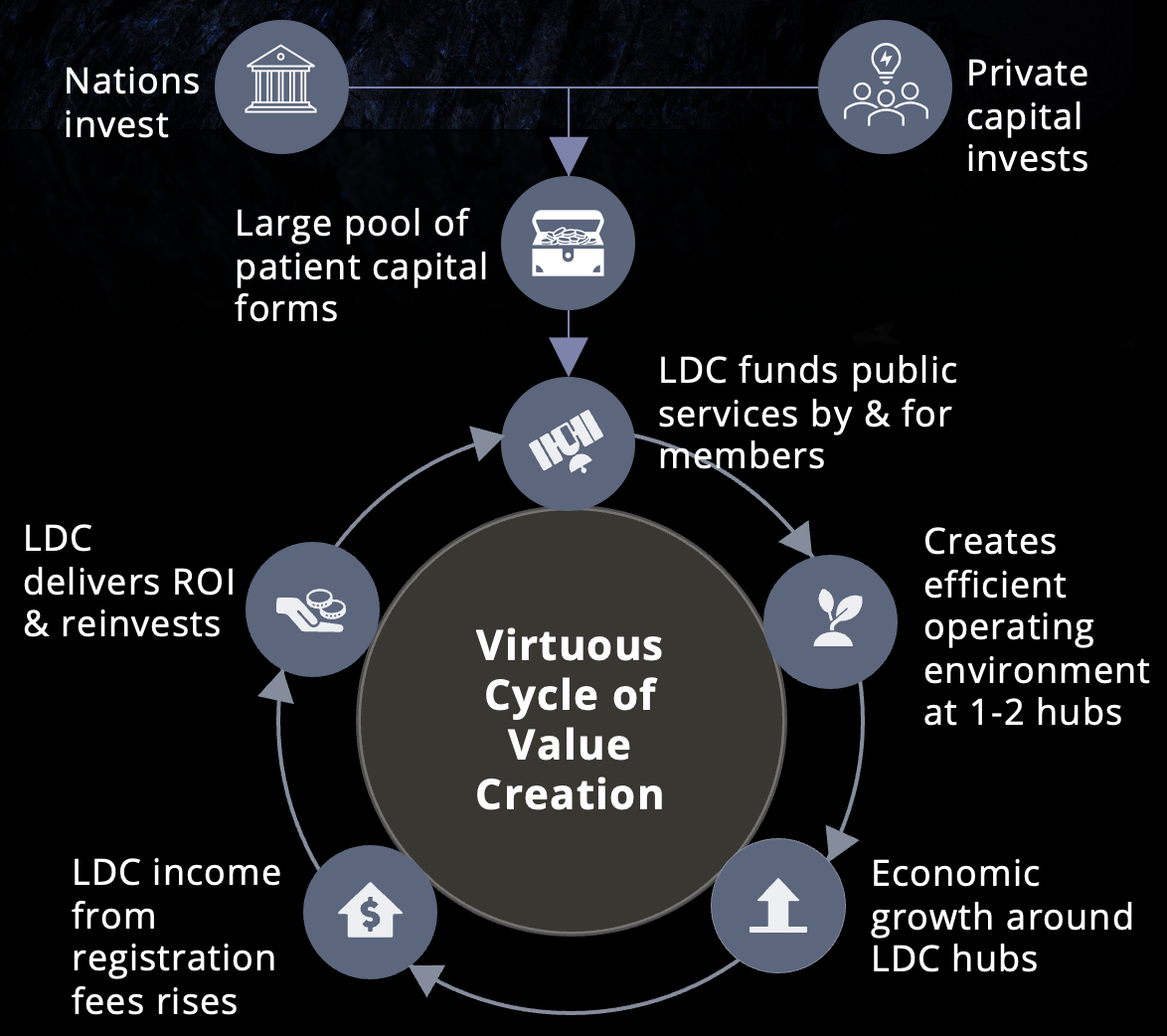
The LDC will mobilize sovereign and private capital from around the world to fund infrastructure to support responsible operations on the Moon.
LDC-funded infrastructure will be available to any space company or government agency that agrees to become an LDC member.
Members will help develop, and be contractually bound to, shared standards and rules of conduct designed to reduce risk and conflict – laying the foundations for a sustainable lunar economy.
The Challenge
Growing a lunar economy requires infrastructure that expands access for a broad range of customers and suppliers from many nations. Yet, no single government or company is likely to make the long-return investments needed to lower barriers to entry for all. And, when certain locations become popular, who will help prevent interference and conflict?
What Is the LDC?
A funder of shared infrastructure for space companies & government agencies that opt-in as members.
Nations buy up to 49% of LDC shares. The private sector buys the rest. Developing nations have affordable access to shares.
A public-benefit company with safeguards to align its incentives with the long-term interests of the lunar economy.
A voluntary organization for developing shared standards & contractual rules of conduct to reduce risks and costs among members.
Manages a registry to prevent conflict at high-demand locations & deposits.
Operationalizes international agreements like the Outer Space Treaty & UN principles through the terms of its member contracts.
How It Works
The Origins of the LDC
The LDC idea originated from Michael Castle-Miller, a lawyer and policy advisor to governments and investors setting up special jurisdictions.
Special jurisdictions are areas with different laws and policies than the rest of their countries – like special economic zones, free trade zones, and semi-autonomous cities.
After starting his career at the World Bank, Michael began helping governments draft new legislation, establish regulatory authorities, and create strategies for promoting economic development for projects like these around the round, in over 35 countries. He became a Partner at DGA-Albright Stonebridge Group, where he led the Special Economic Zones Practice until 2025.
Through his approach, special jurisdictions offer the opportunity to introduce new governance institutions that can catalyze growth in challenging settings. Many of the barriers to creating a lunar economy are similar to those Michael has helped special jurisdictions overcome on Earth. Whether it’s helping build economies in nations like Somalia, Afghanistan and Bhutan, or fostering inclusive development in refugee camps and remote islands, the core issues often include:
An insufficient legal framework
The need to finance infrastructure with highly uncertain returns.
Potential for oligopolies and exclusion.
– much like the challenges facing the Moon.
As a result, in 2019, Michael began working with Hoyt Davidson, a space finance expert, on a practical framework for supporting a lunar economy. They borrowed lessons from the theory and practice of terrestrial economic development and received input from several experts from the space community.
In 2025, the Lunar Development Cooperative concept began gathering a critical mass of support, attracting influential leaders and organizations from around the world – all helping to build it together.
Michael has shifted his full attention to this endeavor out of a conviction that we have an obligation and opportunity to future generations. The institutions that will influence the development of the Moon will have a profound impact on the next several centuries.
Those joining this cause now will help make space more open, free, and prosperous for all.
Why Take Part
Commercial Space Companies:
The LDC will be a new source of funding for space companies, paying them to develop economy-enabling infrastructure for members.
LDC members will have lower risks and costs by using shared services, de-confliction rules, and interoperability standards with other members.
The LDC will greatly expand the market by lowering the barriers for many more nations and companies to operate in space as customers and suppliers.
International Policymakers:
The LDC’s member contracts operationalize international agreements and make space law more effective by translating general principles into specific, binding, and enforceable terms.
The LDC is a highly practical and efficient institution for implementing international norms and does not need a new treaty or an international regulatory authority to operate.
Nations with Major Space Programs:
The LDC bears responsibility for economic development, shifting the burden off government space agencies and allowing them to focus resources on their core mandates (e.g., science, exploration, and inspiration).
Nations Without Major Space Programs:
The LDC is an infrastructure investment, not a space budget appropriation, allowing nations to use already existing investment reserves to develop space capabilities.
LDC infrastructure will greatly lower barriers to operating on the Moon, allowing more nations to demonstrate their capabilities and build national prestige.
The LDC will make stock options available to developing nations and indigenous groups, allowing them to invest more affordably than advanced nations.
Large Commercial Space Companies:
Large scale infrastructure requires an enormous capital investment that does not yield returns for several decades – and most of the value it creates is externalized. This means ordinary private-sector companies will be far less able to provide major infrastructure independently at a quality comparable to LDC-funded infrastructure.
Even the largest companies on Earth rely on shared roads, seaports, power, and communications infrastructure. If they had to build all this themselves, it would be too difficult to generate a profit within a time horizon acceptable to their investors. The same is true in space – with the LDC, companies can shift their resources to more profitable business activities.
Smaller companies will be reluctant to rely on infrastructure provided by a potential competitor in their market, making it difficult for major commercial infrastructure providers to earn their trust.
Humanity:
The LDC will enable everyone on earth to directly benefit financially from the space economy by making its shares available on a universally accessible trading platform at a very low minimum investment.
LDC shares are an asset that will rise in value proportionally to the overall level of lunar development, enabling the world’s poor to have an equity stake in space.
More About the Concept
Videos:
LDC Concept Explainer Video Series
Short, 2-5 minute videos outlining the concept, including:
The concept’s origins and terrestrial analogues
The challenges to creating a sustainable lunar economy that the LDC addresses
How the LDC is structured and kept in check
How the LDC deconflicts activities and prevents interference at high-value lunar locations.
The LDC’s business model
How the LDC avoids interference from non-members
Downloadable Resources:
A concise document presenting the information outlined above about the LDC concept.
The most comprehensive description of the LDC concept yet. Published in the Beyond Earth Institute’s 2024 Reports and Recommendations.
Citation: Michael Castle-Miller, “The Lunar Development Cooperative: A Framework for the Sustainable Development of Space” in Beyond Earth Institute Leadership Council, 2024 Reports and Recommendations (Steven Hoeser & Lauren Andrade, eds) (2024).
The Lunar Development Cooperative: A Transnational Framework for a Sustainable Lunar Economy
A more concise description of the LDC concept, presented at IAC 2025
Citation: Michael R. Castle-Miller, Brent Sherwood, Hoyt Davidson, Steve Wolfe, Andrew Aldrin, Bhavya Lal, Michael Nayak, Pablo Moncada, & Duncan Blake, The Lunar Development Cooperative: A Transnational Framework for a Sustainable Lunar Economy (manuscript presented at the Int’l Astronautical Cong. (IAC) 2025) (IAC-25-E3,IP,21,x101270).
Lunar Freeports and Economic Zones: The Role of Special Jurisdictions in Space
Analyzing the role of historic freeports and their potential application to space.
Citation: Michael R. Castle-Miller and Brent Sherwood, Lunar Freeports and Economic Zones: The Role of Special Jurisdictions in Space (manuscript submitted for presentation at the Int’l Astronautical Cong. (IAC 2025) (IAC-25-E6,IP,20,x100653).
How You Can Take Part
Join our contact list to keep up with our progress.
Support the Lunar Development Institute, and be one of the first people to help establish a practical model for the responsible development of the Moon.
Space Industry, Policymakers, & Research Organizations:
Join the core group shaping the LDC.
Philanthropists, Grant Funders, and Investors:
Contact us to build the foundation for a sustainable lunar economy as an LDI anchor supporter.